Call for Information:
+92 302 0422183

Amount of Zakat al Fitr 2024

Across the Globe

What is Zakat al Fitr?

In Islamic tradition, Zakat al-Fitr, also referred to as Sadaqat al-Fitr or Zakat al-Fitrah, is a mandatory form of charitable giving for every capable Muslim at the end of Ramadan. This is an act of alms-giving to facilitate the celebration of Eid al-Fitr, the festival marking the end of Ramadan, by providing assistance to those in need.

When should Muslims pay Zakat al Fitr?

In Islam, Zakat al-Fitr becomes obligatory from sunset on the final day of fasting and continues until the commencement of Eid prayer, shortly after sunrise the next day. Nonetheless, it can be settled earlier than this timeframe. Historical records indicate that certain companions of the Holy Prophet ﷺ, known as Sahabah (اصحاب النبی ﷺ), paid it a few days before Eid al-Fitr. The prescribed amount of Zakat remains uniform for all, irrespective of income: it comprises a minimum of one sa` (equivalent to four double handfuls) of food, grains, or dried fruits for each family member, or its monetary equivalent.

Importance

Similar to Zakat, Sadaqat al-Fitr also plays a significant role in wealth distribution within Islamic society. However, unlike Zakat, Sadaqat al-Fitr requires each individual to calculate their own and their dependents’ charitable dues and actively seek out deserving recipients within the community. Consequently, Sadaqat al-Fitr fosters the strengthening of community ties. It necessitates direct interaction between the affluent and the impoverished, as well as between different strata of society. This interaction facilitates the establishment of genuine bonds of kinship and compassion within the Islamic community, while also instilling a sense of generosity in those who possess wealth towards those who are less fortunate.
  • pay-charity-sadaqah-2025-1
    General Donations

    Pay Sadaqah (Charity) – Donate Once

    Donate Now

    Your charity can support Shauoor’s charity eligible cases, programs and projects.

What is Fidyah?

When a person has either become extremely weak due to old age, or they are suffering from an illness which prevents them from fasting, they are not obliged to fast during Ramadan. Instead, if they have the means, they must feed a person in need two meals for every day of Ramadan.

What is Kaffarah?

If you break or miss a fast in Ramadan intentionally and without a valid reason, you must fast consecutively for 60 days. (This excludes days when it is forbidden to fast, such as Eid and when a woman is menstruating). If you miss a fast during these 60 days, you will need to start from the beginning, to ensure your 60 fasts are consecutive. If you are physically unable to do this, you are required to pay the Kaffarah (expiation).

Kafara Amount 2024 in Pakistan

Mufti Muneeb stated that Muslims are required to pay Kaffara if they break a fast without a valid reason. According to Islamic guidelines, Kaffarah entails providing two meals to 60 deserving individuals. This entails an expense of Rs18,000 for two kilograms of wheat flour, Rs36,000 for four kilograms of barley, Rs144,000 for four kilograms of dates, and Rs264,000 for four kilograms of raisins.

Reference:

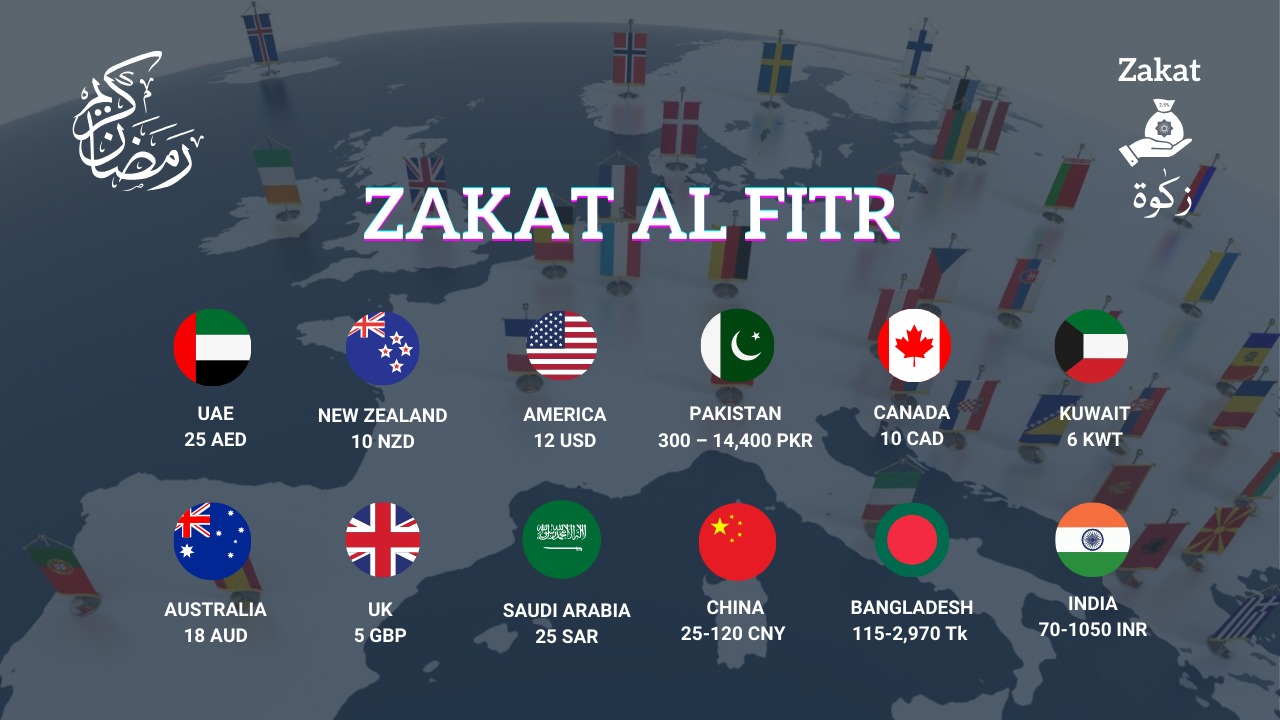
Zakat ul Fitr in Different Countries

Pakistan

PKR 300 – 14,400

United States

US $ 12.00

United Arab Emirates

AED 25

India

INR 70 – 1,050

Australia

Australian $ 18

Saudi Arabia

SR 25

CANADA

CAD 10$

Bangladesh

Tk 115-2,970

China

CNY 25-120

United Kingdom

GBP £ 5

New Zealand

NZ $ 15

Kuwait

KWD 1.5

How much is FITRANA for Ramadan 2024 in Pakistan?

Different Ulemas including Mufti Muneeb Ur Rehman did the Fitra calculation 2024 and revealed the amount for Sadqa Fitr 2024 in Pakistan. The Fitrana amount 2024 Pakistan related to wheat, barley, dates, raisins, and Ajwa dates Zakat Al Fitr is:

Wheat (Gandum)

Rs 300

Dates (Khajoor)

Rs 2400

Barley (Jau)

Rs 600

Raisins (Kishmish)

Rs 4400

Dates/ Ajwa Date

Rs 14400

Raisins (Kishmish)

Rs 4400

Fidya Amount 2024 in Pakistan

Wheat (Gandum)

Rs 300 Or Rs 9000 for 30 fasts

Barley (Jau)

Rs 600 Or Rs 18,000 for 30 fasts

Dates (Khajoor)

Rs 2400 Or Rs72,000 for 30 fasts

Raisins (Kishmish)

Rs 4400 Or Rs 132,000 for 30 fasts

Dates/ Ajwa Date

Rs 14,400 Rs 4,320,00 for 30 fasts

Amount of Zakat al Fitr 2024 Across the Globe

United States

US 12.00

According to Fiqh Council of North America, the estimated recommended value of zakat al-Fitr, for 2024, in the United States, is US $12.00 per eligible person.

Reference:

United Arab Emirates

AED 25

According to Khaleej TImes, the estimated recommended value of zakat al-Fitr, for 2024, in the United Arab Emirates, is 25 AED per eligible person.

Reference:

India

INR 70 – 1,050

By Markazul Ma’arif in Jogeshwari is Rs 70 (1.5 kg of wheat) or Rs 140 (3.5 kg barley) or Rs 900 (3.5 kg of dates) or Rs 1,050 (3.5 kg raisins)

Reference:

Australia

Australian $ 18

If we translate the amount needed for Fitrana into a monetary value based on the price of a staple food, such as flour or rice, it is approximately $18. Therefore, the amount due for each person is $18. This is the amount set by ANIC for 2024.

Reference:

Saudi Arabia

SR 25

The Council of Senior Scholars in Saudi Arabia has determined that the amount of Zakat al-Fitr in cash is thirty Saudi riyals.

Reference:

Bangladesh

Tk 115-2,970

The maximum amount rises to Tk 2,970 per person

Reference:

Canada

$ 10

Reference:

China

CNY 25-120

Reference:

United Kingdom

GBP £ 5

Reference:

New Zealand

NZ $ 15

Reference:

Kuwait

KWD 1.5

Reference

Categorization - Zakat Ul Fitr

Sadaqat al-Fitr is deemed obligatory (واجب) for every Muslim, regardless of gender or age, provided they possess the means to fulfill it. In accordance with Islamic tradition (Sunnah), Ibn ‘Umar narrated that the Holy Prophet ﷺ mandated Zakat al-Fitr for all members of the Muslim community, including slaves, free individuals, males, females, young, and old. The specified amount was one Saa` of dried dates or one Saa` of barley. The head of the household may fulfill the obligation on behalf of other family members. Abu Sa’eed al-Khudree recounted, “During the lifetime of Allah’s Messenger, we used to give on behalf of our young and old, free individuals and slaves, one Saa` of grain, cheese, or raisins.”

Purpose

The primary aim of Zakat al-Fitr is to enable the impoverished to partake in the celebration of the festival of breaking the fast (`Eid al-Fitr) alongside the rest of the Muslim community.

Its objectives include:

  1. Serving as a duty incumbent upon fasting individuals. This is underscored by the hadith stating, “The fasting of the month of fasting will be hanging between earth and heavens and it will not be raised up to the Divine Presence without paying the Zakat al-Fitr.”
  2. Purifying those who fast from indecent actions or speech and providing aid to the poor and needy. This perspective is supported by the hadith of Ibn `Abbas, wherein it is narrated that “The Prophet of Allah enjoined Zakat al-Fitr on those who fast to shield them from any indecent act or speech, and for the purpose of providing food for the needy”.

Conditions

Zakat al-Fitr is obligatory (واجب) and must be distributed within a specified timeframe. Failure to do so without valid justification constitutes a sin, necessitating its compensation. This form of charity becomes obligatory from sunset on the final day of fasting until the commencement of Eid prayer (shortly after sunrise on the following day). However, it can be disbursed earlier, as evidenced by the practice of many companions of the Holy Prophet ﷺ who paid Sadaqah al-Fitr a few days prior to `Eid.

In the era following the spread of Islam, jurists allowed its payment from the start and middle of Ramadan to ensure timely delivery to beneficiaries on the day of `Eid. Emphasis is placed on distribution before `Eid prayers to enable recipients to provide for their dependents on the day of `Eid.

One who forgets to fulfill Zakat al-Fitr on time should do so promptly, albeit it will not be considered Zakat al-Fitr.

Amount

The amount of Zakat is uniform for all individuals regardless of their income disparities. The minimum quantity is one sa` (equivalent to four double handfuls) of food, grain, or dried fruit per family member. This calculation is based on the Prophet’s directive, as reported by Ibn ‘Umar, which prescribed Zakat al-Fitr to be one sa` of dried dates or barley.

While the Hanafi school permits payment in cash equivalent to the prescribed amount, other schools (Maliki, Shafi’i, and Hanbali) do not. Nonetheless, the usage of cash has been adopted by many official fatwa councils worldwide.

Distribution

The distribution of Zakat al-Fitr mirrors that of Zakat and is encompassed within its broader framework. Recipients may include the eight categories mentioned in Surat Al-Tawbah [9:60], such as the poor, the needy, collectors of Zakah, reconciliation of hearts, freeing captives, debtors, those fighting for a religious cause, and travelers. Zakat al-Fitr must be allocated to the aforementioned categories exclusively, and cannot be diverted to other purposes.
Scroll to Top